Bistro Group sparks with local concept
THE Conrad S Maison branch of Siklab — formerly a food hall concept by The Bistro Group — seems to reflect a new pivot to further develop their homegrown brands. While the franchise of the US restaurant Dave & Buster’s that they operate at the Opus mall seats 1,500, due to the play area, in terms of dining, this 260- to 290-seater is the biggest outlet of The Bistro Group to date.
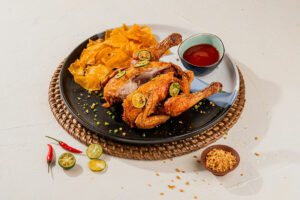
BusinessWorld went to a preview dinner at Siklab on Jan. 7, tasting their Filipino favorites. We particularly liked their Sinilabang Manok (the word siklab means “spark,” so it’s like saying “sparked chicken”), which serves as a version of Bacolod’s inasal (barbecue), that has a very pronounced hit of lemongrass. Their pancit palabok (a noodle dish) can stand toe-to-toe with anybody’s, while their Pinatisang Manok (chicken cooked with fish sauce) is an almost-perfect clone of a heritage fried chicken dish from another restaurant group. Everybody at the table liked their version of bibingka (a steamed rice cake), fluffy like a cake, topped with muscovado sugar, coconut, salted egg, and cheese.
Guia Abuel, chief operating officer of The Bistro Group, said that they had previously launched local brands Siklab and Krazy Garlik in 2014, but had them shuttered in 2018 due to what they thought was their lack of experience in running local brands. After all, The Bistro Group is known for bringing US restaurant franchises here, such as TGI Friday’s (their first) and Morton’s The Steakhouse.
Times have changed, and this Siklab — its largest — is the third branch, after their first relaunch in Shangri-La Plaza mall, then a second branch in Cavite’s Evo City. By the end of the month, Ms. Abuel predicts that they’ll be able to open four more: along Kamagong St. in Makati City, Park Triangle in BGC, Vermosa in Cavite, and at Evia Lifestyle Mall in Las Piñas.
“With the experience we’ve had through the years, we felt that the company is already prepared to come out with a locally conceptualized restaurant,” she said.
“The past few years, we’ve seen successes of local Filipino restaurants. I will not name our competitors, but they were an inspiration for us. We have all cuisines already… but we don’t have a local concept.”
One might think that concentrating on mostly foreign flavors in their decades-long history might prove to be a handicap in making something Filipino, but she says that the systematic operations influenced by their Western counterparts helped them build better. “They have a great foundation of standards,” she said. “It’s an American style of service: friendly, generous.
“We kind of applied these learnings in the way we run our business now, in a homegrown set up,” she said.
On that note, how do they set themselves apart as a Filipino restaurant in the Philippines, counting that most of their experience has been with foreign brands? “There are a lot of good local restaurants, but in terms of execution… I think we can be ahead of them.
“We’re a matured operator. Of course, food is everything, but it’s not everything. It’s the quality of service, the ambiance. It’s a total package.” — Joseph L. Garcia