
First butoh gathering in Asia platforms dance performances, cultural discourse
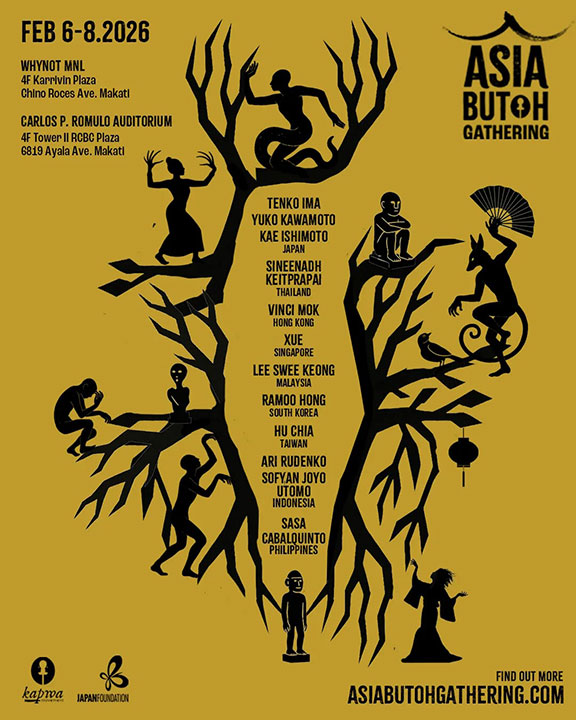 THE Asia Butoh Gathering (ABG) 2026, led by the Kapwa Movement and the Japan Foundation, Manila, is set to take place on the first week of February. The inaugural edition of the festival will have a lineup of performances, workshops, talks, and exchanges exploring butoh as a dance practice responding to various social, cultural, and ecological contexts in Asia.
ABG will serve as “a space for cross-border dialogue, artistic research, and collective reflection through movement and performance.” With the theme “Moving Roots, Moving Cultures,” it also marks 70 years of Japan-Philippines diplomatic relations.
Sasa Cabalquinto, Kapwa Movement founder and ABG program director, said at the media launch on Jan. 19 that the gathering will be the first time that butoh practitioners from all over Asia will convene.
“The artists featured here in the festival have been actively pursuing butoh in their own communities, contexts, and cultures,” said Ms. Cabalquinto.
“Butoh is seen as a solitary underground practice. In many parts of Asia, artists usually work in isolation without much access to dialogue, history, or collective community. This festival creates that rare space. This is a once in a blue moon opportunity,” she added.
SHARED PULSEABG will run for three days, welcoming butoh artists from Japan, Thailand, Taiwan, Singapore, South Korea, Malaysia, Indonesia, Hong Kong, and the Philippines. It invites participants to “explore the shared pulse of an Asian identity through embodied movement.”
“Originating from Japan, butoh has a very rich and complex history as a dance, as a movement. Brought as a seed to different lands, to different countries, how did it grow and what does it look like now as a tree, as a plant, as a flower?” said Ms. Cabalquinto. “That’s what ABG is all about, discussing the Japanese artistry but also separating the ways it has rooted, grown, and continued to move forward.”
Butoh emerged in post-war Japan, but the festival’s theme of “Butoh in the Time of Ecological Crisis” addresses a world grappling with environmental collapse and holding on to a desperate hope for renewal.
Ms. Cabalquinto said that the art form “responds to the ecological consciousness,” especially in the Philippines where a lot of natural disasters had led practitioners in the Kapwa Movement to sit and reflect on what has been happening to the earth.
For Vinci Mok from Hong Kong, there’s a line that can be traced from the origins of butoh in Japan to the present day, where many people of different cultures welcome it as a healing practice.
“The spirit of it is very important because it comes from World War II and hard times in Japan. Right now, there are hard times in Hong Kong, so it helps us experience calm,” Mr. Mok explained. “How do we survive in a limited space? Our body is limited, so how do we find our way out? When we live with this kind of philosophy, we move in a way that’s detailed.”
Xue from Singapore told the press that different communities find empowerment in butoh depending on their respective contexts.
“In our community in Singapore, people are quite repressed and shy about our bodies and movement. Butoh is an extremely liberating form of movement for people who are not trained in dance. The community aspect, being able to move together, has inadvertently empowered practitioners to feel more empowered in their movement,” she said.
On Feb. 6, there will be a dialogue held at WhyNot Manila in Karrivin Plaza, Makati City. This includes roundtable conversations featuring speakers from nine different parts of Asia, moderated by Katrina Stuart Santiago. The evening will transition into a physical workshop led by Yuko Kawamoto.
On Feb. 7, attendees can experience a screening of the 84-minute film Darkness Princess Bamboo, followed by lecture-presentations from Japanese masters Kae Ishimoto, Tenko Ima, and Yuko Kawamoto.
“Butoh started in Japan, so we wanted to emphasize in this festival that there have been efforts from the Japanese themselves to bring butoh across Asia,” said Ms. Cabalquinto. “That’s one of the highlights, the Japanese film screenings documenting archives, and lecture presentations.”
The festival will culminate on Feb. 7 at the Carlos P. Romulo Auditorium in RCBC Plaza, Makati City, with the ticketed performance of Falling Earth, Moving Sky, an exploration of ancestry, land, and gender.
“Performances represented here are an embodied response to the world that has been unraveling, remaking itself, and how it affects us as human beings,” Ms. Cabalquinto said.
While the entire festival is free, the general admission tickets for the final performance cost P1,000, with an early bird rate of P800 applicable until Jan. 31. — Brontë H. Lacsamana