UK vehicle output hits lowest level since 1952 as industry pins hope on EV

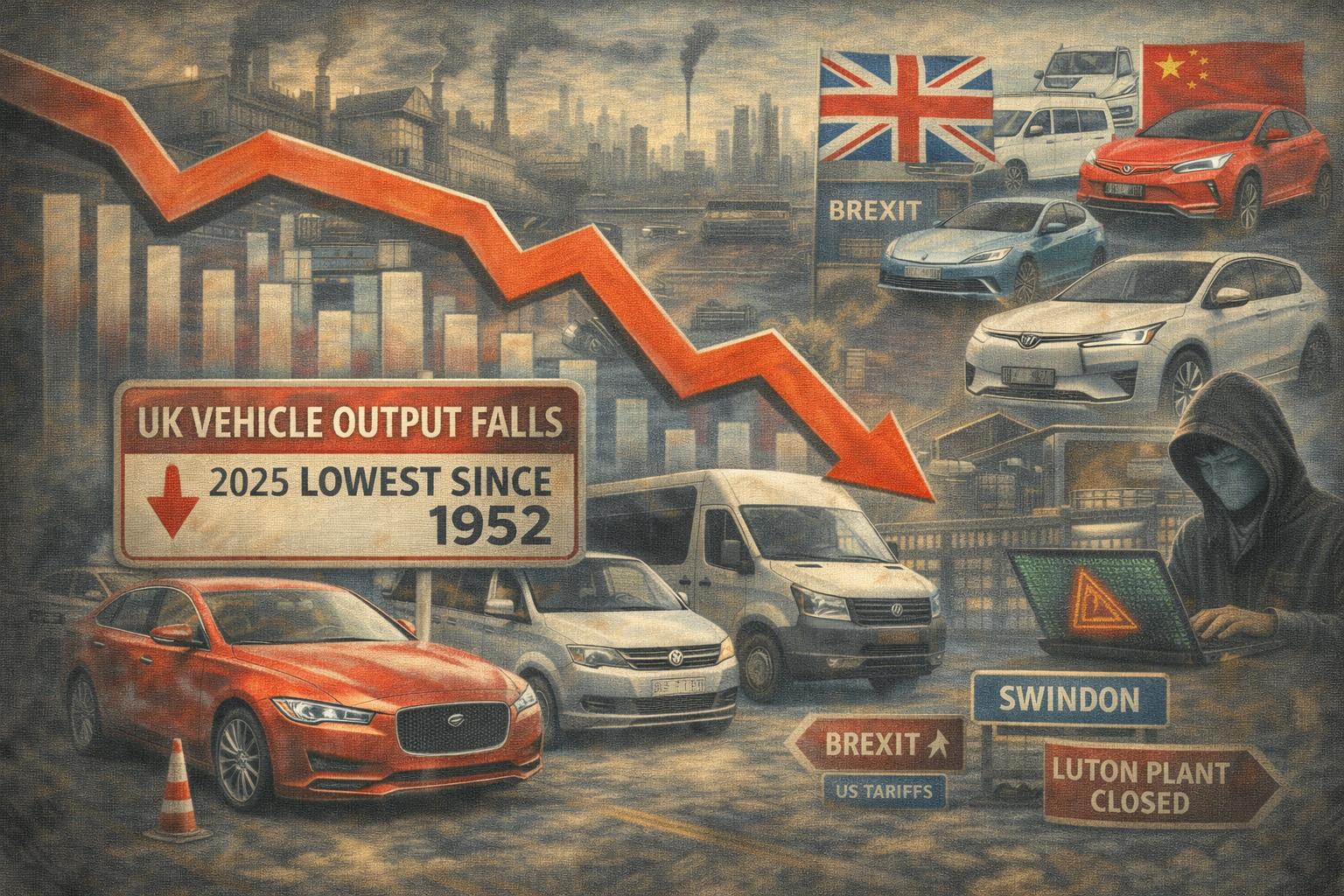
British car, van, truck, and bus production fell to its lowest level since 1952 in 2025, underscoring what industry leaders have described as the most challenging period for UK manufacturing in decades.
According to data from the Society of Motor Manufacturers and Traders (SMMT), total vehicle output dropped 15.5% year on year to 764,715 units.
Of these, 717,371 were cars, around 60,000 fewer than in 2024.
By comparison, UK car production stood at about 1.7 million in 2016.
SMMT chief Mike Hawes called it “the toughest year in a generation” and said hitting the government’s 2035 ambition of 1.3 million vehicles will likely require a new factory.
The industry group expects a recovery as new electric models launch, but warned that policy shifts in Brussels and tariffs in the US are adding pressure.
A three-day visit to China by Keir Starmer and UK business leaders has created hopes for potential inward investment in the UK.
Output slumps after a bruising year
Commercial vehicle output fell 62% to 47,344 after the closure of Vauxhall’s Luton plant in late March, with parent Stellantis consolidating van production at Ellesmere Port.
A major cyberattack at Jaguar Land Rover forced the company to shut down computer systems in early September, halting production for more than a month and taking additional time to return to normal output levels.
Beyond these events, longer-term headwinds include uncertainty over Brexit arrangements, the closure of Honda’s Swindon factory in 2021, the impact of the Covid-19 pandemic, and persistent global supply chain disruption.
With roughly 78% of UK-built cars destined for export, the industry also remains highly exposed to trade policy shifts.
US President Donald Trump’s announcement in April of new tariffs on car imports prompted some manufacturers to curb shipments, even though a later deal removed the threat of higher levies.
The basic tariff on UK car exports to the US still rose from 2.5% to 10%, dampening sales.
Investment needs and European trade risks
The government’s longer-term ambition is to raise production to 1.3 million vehicles a year by 2035.
Hawes cast doubt on that target without major new investment, saying: “To get to 1.3 [million] you kind of need a new plant.”
He suggested Chinese manufacturers are the most likely source of such investment, noting: “In terms of who is expanding their production globally, obviously it’s the Chinese.”
Starmer arrived in Beijing and Shanghai on Wednesday with a delegation that included executives from Jaguar Land Rover, McLaren, and Octopus Energy.
Chinese brands are gaining traction in the UK.
They accounted for 9.7% of new car sales in 2025, nearly doubling their market share in a year as MG, BYD, and Chery expanded.
The UK has not imposed tariffs on Chinese imports, unlike the US or the EU.
Chery said last year that it was “actively considering” building a UK plant as part of its localisation strategy.
At the same time, Hawes warned of growing risks from Europe, pointing to what he described as an increasingly protectionist “Made in Europe” approach.
“Unless the UK can be seen as part of that, these proposals could have the effect of delivering what Brexit didn’t deliver – and that’s making it much harder for UK produced vehicles to access the European market,” he said. “So this is a significant threat.”
EV transition and hopes for recovery
Despite the weak backdrop, the SMMT expects conditions to improve in 2026 as production of new electric models gathers pace.
Hawes said there is a “pathway” to lifting combined car and van production above 1 million units a year by 2027, a target he described as “optimistic but realistic.”
Car output is forecast to rise by about 10% this year, supported by new model launches.
Nissan’s latest electric Leaf began rolling out of its Sunderland factory in mid-December, while Jaguar Land Rover is preparing to produce a new electric Range Rover and the first models in a new generation of electric Jaguars at its Solihull plant later this year.
The post UK vehicle output hits lowest level since 1952 as industry pins hope on EV appeared first on Invezz