Jobless rate rises to 2-year high in 2025
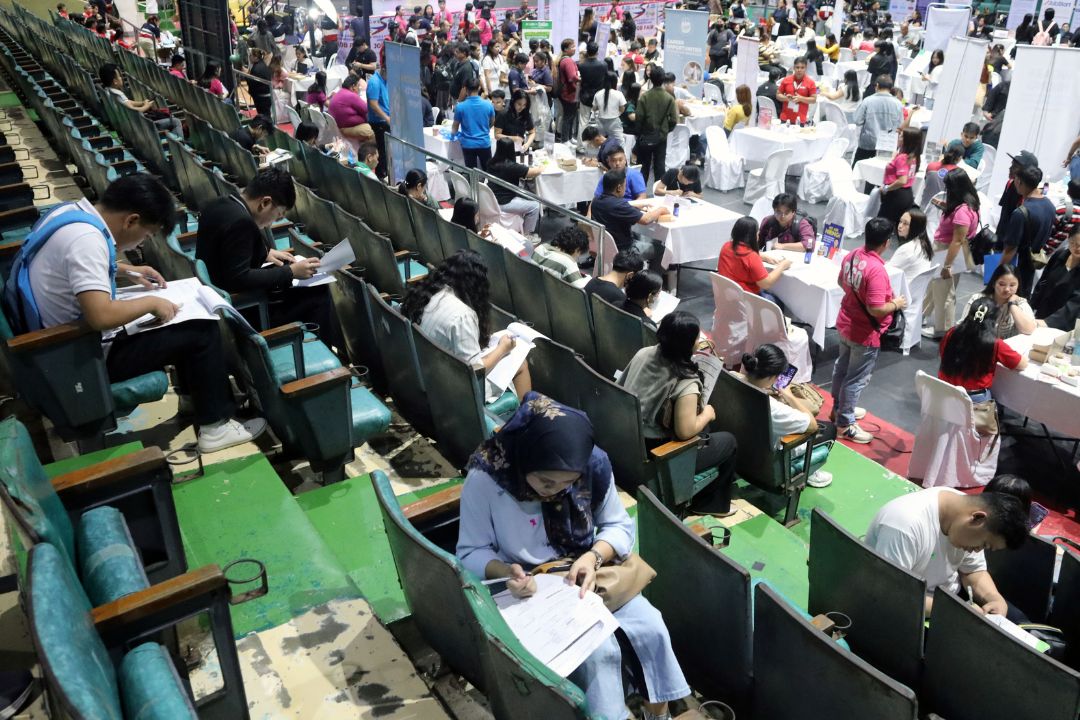
THE COUNTRY’s unemployment rate rose to 4.4% in December amid a sharp contraction in construction jobs, bringing the full-year average to a two-year high of 4.2%, data from the Philippine Statistics Authority (PSA) showed.
Preliminary data from the Labor Force Survey (LFS) showed the jobless rate in December was higher than the 3.1% posted in December 2024. However, this was unchanged at 4.4% from November.
The number of unemployed Filipinos increased to 2.26 million in December, higher than the 1.63 million logged in December 2024 and the previous month’s count of 2.25 million.
For 2025, the jobless rate averaged 4.2%, equivalent to 2.14 million jobless Filipinos. This was higher than the 3.8% jobless rate in 2024, which translated to 1.94 million jobless Filipinos.
The 2025 unemployment rate was the fastest in two years or since the 4.4% posted last 2023.
National Statistician Claire Dennis S. Mapa attributed the drop in unemployment in December to declines in public construction.
The construction sector recorded the largest job losses in December, shedding 550,000 workers year on year, while administrative and support services posted the biggest gain with 385,000 additional workers, PSA data showed.
“We know from our fourth-quarter GDP (gross domestic product) report that in the fourth quarter, [the growth rate] in construction really declined. It was negative there in construction, particularly public construction,” Mr. Mapa said in mixed English and Filipino.
The country’s GDP growth eased to 3% annually in the fourth quarter, the slowest growth recorded since the 3.8% contraction in the first quarter of 2021 at the height of the coronavirus pandemic.
This dragged the full-year growth to 4.4% in 2025, the lowest growth in five years or since the pandemic-induced contraction of 9.5% in 2020. It fell short of the government’s 5.5% to 6.5% target amid the multibillion-peso flood control scandal.
In a research note, Chinabank Research said the job losses in construction were due to reduction of government outlays on infrastructure projects in the final three months of 2025.
“Job creation in the sector may remain subdued as heightened scrutiny amid governance concerns may continue to delay public construction activities,” Chinabank Research said.
“Climate impacts and corruption scandals made a significant dent on employment in 2025,” said University of the Philippines Diliman School of Labor and Industrial Relations (UP SOLAIR) Assistant Professor Benjamin B. Velasco in a Messenger chat.
“Rains and floodings from so many typhoons, including several strong ones, severely affected climate vulnerable sectors like agriculture and fisheries. Meanwhile the ban on flood control projects in the wake of the massive corruption scandal hit jobs in construction,” he added.
Meanwhile, job quality improved as the underemployment rate slipped to 8% (3.93 million), down from 10.9% (5.48 million) in December 2024 and 10.4% (5.11 million) in the previous month.
This was also the lowest underemployment rate since April 2005, when the PSA redefined underemployment as individuals who are employed but seek additional jobs or work hours.
“The decline in underemployment allows workers to participate in the upskilling and reskilling initiatives to be rolled out by government,” said Department of Economy, Planning, and Development Undersecretary Rosemarie G. Edillon in a statement.
“We will continue to work closely with Congress to institute reforms to make our labor market environment dynamic and responsive to the evolving world of work.”
For 2025, the average underemployment rate held steady at 11.9% since 2024. This is equal to 5.823 million underemployed Filipinos last year, higher than 5.818 million in 2024.
Chinabank Research said that underemployement usually eases near the yearend due to higher discretionary income.
“A lower underemployment rate does not necessarily imply improved job quality, as some underemployed workers may have exited the job market in December amid weak demand,” it added in a note.
Josua T. Mata, secretary-general of Sentro ng mga Nagkakaisa at Progresibong Manggagawa, said that the rise in unemployment during December “when employment should have peaked” was caused by low-quality jobs.
“The corruption scandal and the government’s bungled response played a major role in this dismal outcome. Construction alone lost a massive number of jobs after the government chose to freeze projects rather than decisively address corruption,” he said in a Viber message.
Employment rate dipped to 95.6% in December from the 96.9% posted in December 2024 but remained steady from November.
The December figure represented 49.43 million employed Filipinos, down from 50.19 million workers in December 2024. However, this was an increase from 49.26 million workers in November.
For 2025, the average employment rate fell to a two-year low of 95.8%, from the 96.2% logged in 2024. This accounts for 49.01 million employed Filipinos in 2025, higher than the 2024 average of 48.84 million.
“Admittedly, in our data over the last three years, this is the lowest additional employed persons year on year,” said Mr. Mapa.
“In 2023 versus 2022, our addition there was 1.29 million. In 2024 versus 2023, our addition in employed persons was 664,000. And this 2025, 172,000. So it’s lower compared to the past two years.”
Meanwhile, the labor force participation rate (LFPR) edged down to 64.4% in December from 65.1% a year earlier, though it ticked up from 64% in November. The labor force totaled 51.69 million, down from 51.81 million in December 2024 but up from 51.52 million in November.
This brought the country’s workforce size to an average of 51.16 million in 2025, up from 50.78 million in 2024. This translated to an LFPR of 64.1% in 2025, down from 64.4% in 2024.
In December, the services sector employed the most workers, accounting for 62.4% of the total workforce.
The agriculture and industry sectors came next, accounting for 20.7% and 16.9% of the total number of employed individuals, respectively.
Wage and salary workers made up the majority of employed Filipinos in December at 64.2%, followed by self-employed individuals without paid employees (27.4%), unpaid family workers (6.9%), and employers in family-operated farms or businesses (1.5%).
For UP SOLAIR’s Mr. Velasco, climate remains an employment risk this year.
“Climate is both a risk and opportunity. If we make a decisive shift to public employment in green jobs, then we can open up possibilities amid a crisis,” he said. — Pierce Oel A. Montalvo