
PHL urged to phase out VAT exemptions for seniors, schools

THE PHILIPPINES should reduce fiscal incentives and phase out value-added tax (VAT) exemptions for senior citizens and private education to trim debt and narrow the budget deficit, the Organisation for Economic Co‑operation and Development (OECD) said.
The Philippine government must accelerate its pace of fiscal consolidation, with reforms to mobilize revenues and enhance spending efficiency to put “public debt on a more prudent path,” the OECD said in the maiden launch of its Economic Survey of the Philippines.
“There are three avenues to optimize fiscal consolidation. One is to optimize growth and let the increased revenue go to the bottom line,” OECD Secretary-General Mathias Cormann said at the launch event on Thursday.
“Two is to better control expenditure growth and three is to optimize your revenue mix including by reform to relevant tax arrangements including those related to VAT.”
The Philippines’ total outstanding debt stood at P17.71 trillion in 2025, bringing the debt ratio to 63.2% of gross domestic product (GDP), the highest annual ratio in 20 years, or since the 65.7% in 2005.
The OECD projected that the public debt share of the GDP will hit 62.4% in 2026, before easing to 61.6% in 2027.
“Combining fiscal consolidation with structural reforms lifting the economy’s growth potential by around 1 percentage point, the same fiscal strategy would reduce public debt to around 51% of GDP by 2040. This would limit debt servicing costs and create fiscal space to deal with future domestic and international economic shocks, including natural disasters to which the Philippines is highly exposed,” it said.
As part of its key recommendations, the OECD said the government should phase out VAT exemptions and corporate tax incentives such as tax holidays.
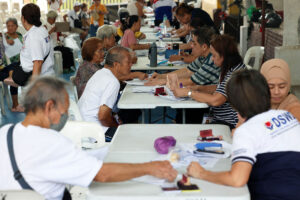
“Phasing out VAT exemptions for private healthcare, education and senior citizens, combined with targeted social transfers, would raise revenues while improving the efficiency and equity of the tax and benefit system,” it said.
For instance, senior citizens are entitled to a 12% VAT exemption under the Expanded Senior Citizens Act.
The OECD’s recommendation is similar to the International Monetary Fund’s (IMF) earlier suggestion that the Philippine government increase VAT revenue by removing exemptions and zero-ratings, such as senior citizens’ VAT exemption.
The government should also gradually phase out tax holidays and shift to expenditure-based corporate tax incentives “to realign incentives with efficiency and fiscal discipline,” the OECD said.
The OECD also said the government should consider the introduction of a tiered social protection system, including a gradual expansion of non-contributory pensions and lower mandatory social contributions for low-wage workers.
It noted that only around one-third of employed Filipinos have formal sector jobs with full social and labor market protections.
“Establishing a universal basic pension that includes the remaining third of the old-age population who currently do not receive any pension benefit could prevent old-age poverty, regardless of individual work histories in the formal and informal sectors,” it said.
The government should also shift the financing of universal healthcare to general taxes from social security contributions, the OECD said.
It also backed public administration reform and the overhaul of the pension system for military and uniformed personnel (MUP) to enhance public spending efficiency.
“(These) are positive steps to enhance the efficiency of spending and bolstering long-term fiscal sustainability but would only yield limited savings in the short term. For instance, the envisaged MUP pension reform would yield savings of less than 0.05% of GDP in the short term,” the OECD said.
SLOWING GROWTHMeanwhile, the Philippines is facing “significant headwinds” to maintaining high growth amid slowing population growth and rising climate risks, the OECD said.
In its report, the OECD kept its Philippine GDP growth forecasts at 5.1% for 2026 and 5.8% for 2027, “as inflation remains low and financial conditions ease.”
These forecasts are within the government’s 5-6% target this year and the 5.5-6.5% goal for 2027.
This would be faster than the 4.4% expansion in 2025 when a corruption scandal dragged growth, investment, public spending, and consumer confidence.
“Slower global trade and population ageing imply that previous growth engines can no longer be taken for granted. Sustaining high growth will increasingly depend on boosting productivity,” it said.
To achieve the country’s ambition of becoming a predominantly middle-class society by 2040, the OECD said average annual productivity growth will have to rise from 4.5% in the pre‑pandemic period to 5.2% until 2040. It noted that GDP growth would have to average around 6% from 2025 to 2040, well-above the 2011-2024 average of 4.8%.
“The Philippines set a clear ambition to triple per capita income by 2040. We are building on a solid foundation of sustained growth, poverty reduction, and macroeconomic stability,” Finance Secretary Frederick D. Go said in a speech.
Under the AmBisyon Natin 2040, the Philippines aims to triple Filipinos’ income per capita relative to 2015 to $11,000 by 2040.
Meanwhile, the OECD said risks to the economic outlook remain skewed to the downside.
“A more persistent-than-expected weakness in public investment related to tighter corruption controls and weaker investor confidence could weigh on domestic demand over 2026,” it said.
On the upside, recent liberalization of foreign investment rules and expanded fiscal incentives may help attract stronger capital inflows, helping offset headwinds from exports.
COMPETITION REFORMSMeanwhile, the OECD also called for reforms that would open up competition in the energy and telecommunication sectors, as well as ease barriers to foreign investment and trade.
“Enhancing competition in network industries — especially electricity and telecommunications — is a precondition for rapid digitalization and can lower input costs and enhance productivity in downstream sectors, including manufacturing,” it said.
For the power sector, the OECD recommended the vertical separation of electricity generation and distribution companies, as well as requiring distributors to exit retail supply activities.
In the telecommunication sector, the OECD said telecommunication network owners should be required to provide nondiscriminatory access to infrastructure at regulated tariffs. It also said the National Telecommunications Commission should be granted full autonomy and transparent oversight powers.
“But legislative franchise requirements could be lifted for the telecommunications industry more broadly, replacing them with standardised licences issued directly by the NTC, thus removing political interference and procedural delays,” it said.
The OECD also said establishing a single‑window approval system with simplified procedures, strict turnaround times, and digital tracking would strengthen the investment climate.
It also called for a more aggressive anti-corruption campaign through prevention, investigation, and prosecution, noting that perceptions of corruption among citizens and businesses remain “very high.”
CLIMATE CHANGEThe Philippines, already vulnerable to heat waves, typhoons, and flooding, may face mounting economic losses as climate change intensifies, the OECD warned.
Growth shocks, inflationary pressures, and fiscal strain from reconstruction spending could erode long-term stability, it said.
The OECD recommended prioritizing adaptation in disaster-prone regions, particularly in rural areas, through climate-resilient infrastructure, early warning systems, and integrated land-use planning.
“Increasing the coal excise tax and aligning all energy excise taxes with carbon dioxide content would strengthen price signals and support climate objectives,” the OECD said.
Despite a moratorium on new coal-fired power plants since 2020 to reduce emissions, it remains the dominant source of electricity, and low excise taxes undermine incentives to shift to cleaner energy, it added.
The OECD also urged the government to broaden its moratorium on new coal-fired plants to include extensions of existing facilities, proposing a reverse auction scheme in which operators bid for compensation to shut down generation in exchange for carbon credits.
The current levy of P150 per metric ton, equivalent to about 1.04 euros per ton of carbon dioxide, falls short of global estimates of the social cost of carbon.
Under a high-emissions scenario, Philippine GDP losses are projected to reach 5% by 2040, accelerating to 20% by 2070 relative to a no climate-change baseline. — Aubrey Rose A. Inosante