Philippines, US seal $4.2-M deals to expand civil nuclear cooperation

THE PHILIPPINES is gaining more support from the United States in its goal of integrating nuclear power into the national energy mix in the next six years as it sealed $4.2 million worth of deals with US companies.
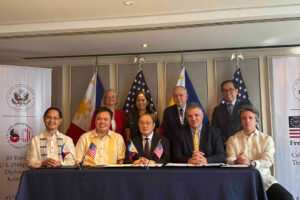
Government agencies and private companies from the Philippines and the US on Monday entered into memoranda of understanding which are aimed at exploring deployment of nuclear technology and supporting nuclear workforce development in the country.
“The Philippine Energy Plan sets clear direction for an energy future — 1,200 megawatts (MW)by 2032. And that is not moving until somebody tells us that it’s impossible,” Energy Secretary Sharon S. Garin said in her speech during the signing ceremony in Makati City on Monday.
“These targets demand preparation, anchored in discipline, safety, and capacity. As we pursue energy security and a responsible transition, we must invest in our people as deliberately as we invest in infrastructure,” she added.
Under the Philippine Energy Plan, the country aims to integrate nuclear energy into the power mix with at least 1,200 MW of capacity by 2032, rising to 2,400 MW by 2045 and to 4,800 MW by 2050.
“We want to work together to get the Philippines to the finish line on nuclear energy,” Ann K. Ganzer, principal deputy assistant secretary at the US Department of State’s Bureau of Arms Control and Nonproliferation, said.
“Beyond acquiring the technology and establishing robust regulations, to achieve that 2032 goal, the most vital elements will be assessing sites for commercial reactor and developing the skilled workforce needed to design, construct, operate, regulate and sustain advanced nuclear plants for generations to come,” she added.
Manila Electric Co. (Meralco), the country’s largest private electric distribution utility, secured a $2.7-million grant from the United States Trade and Development Agency to help the company assess and deploy US-designed small modular reactors (SMRs) in the Philippines.
Meralco will pursue a feasibility study which involves an evaluation of leading US technologies, identification of viable sites, and delivery of a high-level implementation roadmap.
SMRs, each capable of generating up to 300 MW, can be constructed more quickly than traditional nuclear power plants.
Meralco Chairman and Chief Executive Officer Manuel V. Pangilinan described the grant as “the beginning of a long but necessary journey.”
“Meralco is also looking actually at not only SMRs. It depends on the horizon by which we are able to deploy, but also, perhaps a bit sooner, conventional nuclear plants for this country,” Mr. Pangilinan said.
“It simply is right for the country and for Meralco to take nuclear, and we are prepared to act as thought leaders in this regard,” he added.
The US State Department’s Foundational Infrastructure for Responsible Use of Small Reactor Technology Program involves the installation of a $1.5-million nuclear reactor control room simulator at a technical institution within the planned Luzon Economic Corridor.
The simulator will provide hands-on realistic training for future reactor operators, which is aimed at positioning the Philippines as an SMR regional training hub.
Meanwhile, several private companies and government agencies also contributed $2.5 million to bring US nuclear experts to the Philippines to develop specialized vocational and higher education curricula focused on the civil nuclear industry.
The partnership includes Aboitiz Power Corp., US-based integrated energy solutions firm EoS Organization, Technical Education and Skills Development Authority, and the US Department of State led by Fulbright Philippines.
In 2024, the Philippines and the US inked an agreement for cooperation in the peaceful uses of nuclear energy, commonly known as a “123 Agreement.” — Sheldeen Joy Talavera