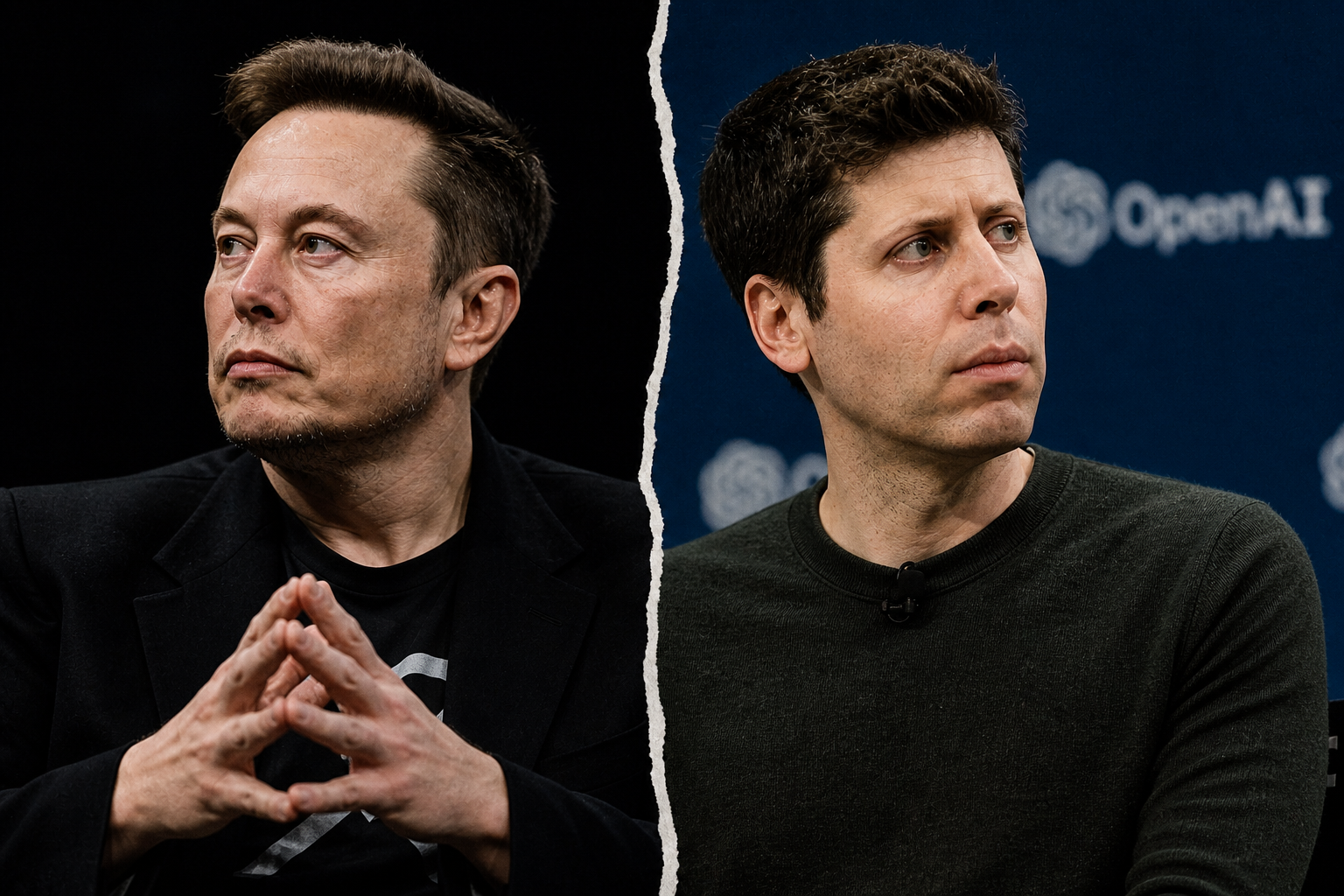
Musk vs. Altman: the $150B lawsuit that could derail the AI IPO of the century
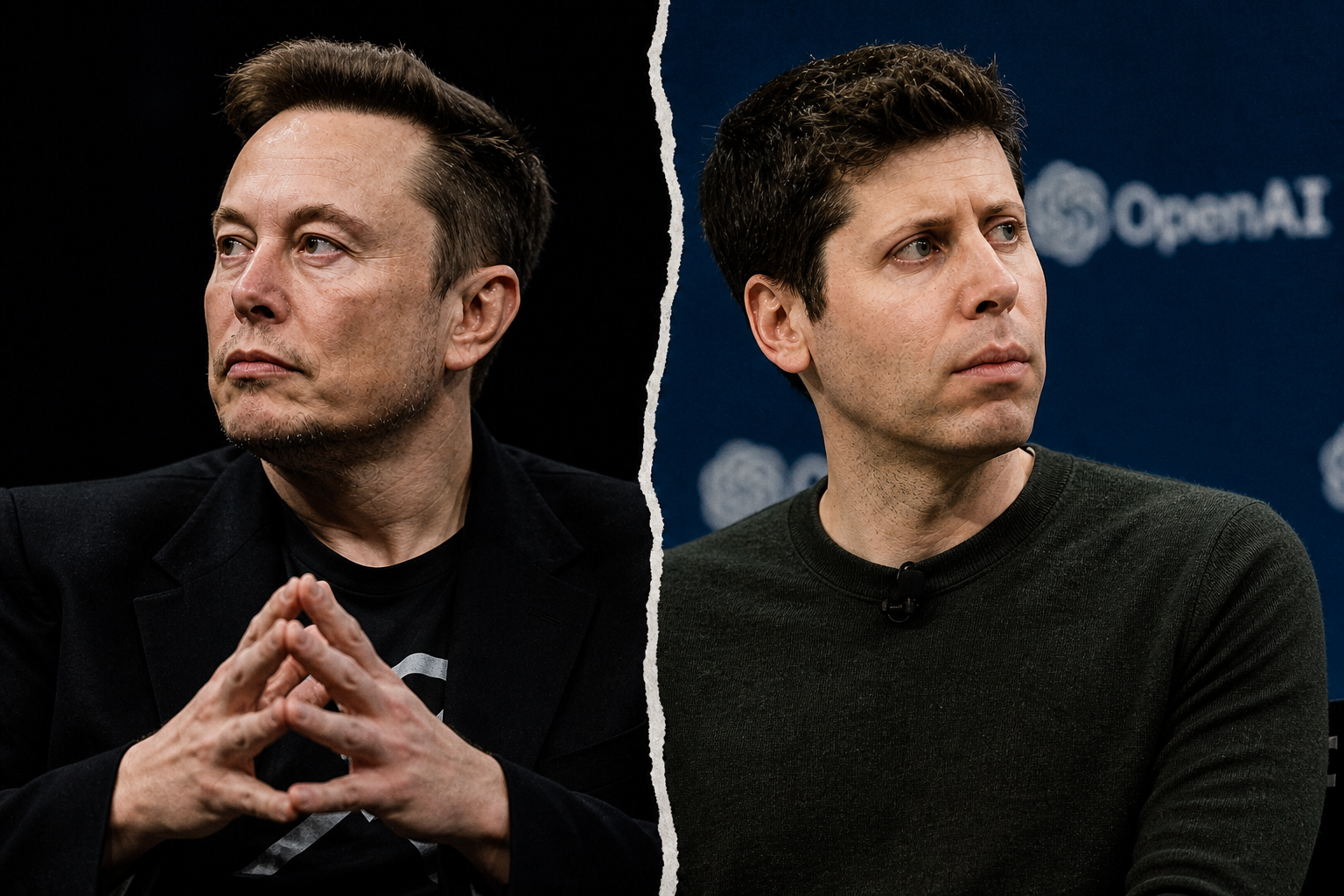
One is the public face of the artificial intelligence boom. The other is the world’s richest man, a leading force behind the electric vehicle revolution and a self-styled futurist.
Now, Sam Altman and Elon Musk are locked in a high-stakes legal battle over the future of OpenAI—the company that helped bring AI into the hands of the masses, in what could reshape not just the AI behemoth, but the governance and structure of the industry itself.
At its core, the dispute, being played out in a federal courthouse in Oakland, California, raises a fundamental question: can an organisation founded as a public-interest nonprofit pivot into a commercial powerhouse without violating its original mandate?
As generative AI becomes embedded in everyday life, the answer carries implications far beyond Silicon Valley boardrooms.
From shared vision to bitter fallout
The origins of the conflict date back to 2015, when Musk and Altman co-founded OpenAI alongside a group of researchers and entrepreneurs.
The initiative was framed as a counterweight to corporate-led AI development, particularly concerns surrounding DeepMind and its parent Google.
At the time, the founders argued that artificial general intelligence was too powerful to be left solely in the hands of profit-driven entities.
OpenAI would operate as a nonprofit, committed to ensuring that the benefits of AI were widely shared.
That vision began to fracture within a few years.
Musk departed the organisation in 2018 after disagreements over its direction and leadership.
In the years that followed, OpenAI introduced a capped-profit structure, enabling it to raise significant capital while maintaining a formal link to its nonprofit origins.
The transformation accelerated after the release of ChatGPT, which became one of the fastest-growing consumer applications in history.
With backing from Microsoft and a rapidly expanding product suite, OpenAI evolved into a central player in the global AI race.
For Musk, that shift represents a betrayal of the company’s founding principles, and he sued in 2024.
“It’s very simple,” Musk testified. “It’s not okay to steal a charity.”
He has also named the OpenAI co-founder, Greg Brockman, and Microsoft, a major investor in the company, in his complaint.
Inside Musk’s claims and demands
Musk’s lawsuit seeks sweeping remedies that could fundamentally alter OpenAI’s structure.
He has called for Altman’s removal from the board, a reversion to nonprofit status, and the recovery of what he describes as “ill-gotten gains” amounting to about $150 billion.
He also argues that his initial financial contribution—roughly $38 million—was used in ways that were not consistent with OpenAI’s original mission.
While Musk has clarified that he is not inherently opposed to a for-profit component, he has repeatedly argued that such a structure should remain subordinate to the nonprofit mission.
The current model, in his view, has inverted that relationship.
Personal tensions come to the fore
The strain between Elon Musk and Sam Altman has been unmistakable throughout the proceedings, underscoring how a once-collaborative relationship has devolved into open hostility.
The two, who moved in the same Silicon Valley circles and co-founded OpenAI in 2015, now find themselves on opposing sides of a deeply personal and high-stakes dispute.
Pretrial disclosures have added to the drama, with both sides releasing internal communications that shed light on past interactions.
Among them were messages shared by OpenAI suggesting Musk had used a former board member to keep tabs on the company.
The proceedings also veered into personal territory, including references to Shivon Zilis, a former OpenAI board member.
When asked about her in court, Musk described her as “my chief of staff and uh, well, yeah,” offering a glimpse into the unusually personal tone of some exchanges.
Another line of inquiry focused on Musk’s alleged ketamine use during key negotiations, though Musk said he did not recall such instances.
The issue was later dismissed as irrelevant by Judge Yvonne Gonzalez Rogers during a pretrial hearing.
Altman’s own deposition added to the picture of a fractured relationship.
He wrote that Musk had previously complained about not receiving sufficient credit for OpenAI’s success and had taken offence at being left out of an anniversary photograph.
Altman also offered a pointed personal assessment, saying, “Probably his whole life is from a position of insecurity. I feel for the guy.”
Three days of testimony lay out Musk’s case
Elon Musk spent three days on the witness stand this week outlining his case against OpenAI and its leadership, offering a mix of philosophical arguments and specific grievances about the company’s evolution.
He began testimony on Tuesday by reiterating a theme familiar in Silicon Valley: that his ventures are built around a broader mission to benefit humanity.
Musk pointed to companies such as Tesla, SpaceX, and Neuralink as examples of that ethos.
OpenAI, he said, was founded with a similar objective before being reshaped by Sam Altman and co-founder Greg Brockman into a highly commercial enterprise.
On Wednesday, during roughly five hours of testimony, Musk sought to clarify that his objections are not to the existence of a for-profit arm itself, but to its dominance.
He said a limited commercial structure could support a nonprofit mission, but argued it should not become the “main event.”
Reflecting on his early involvement, he said he had been “a fool” to contribute $38 million, which he claims ultimately helped build what he described as an $800 billion for-profit company.
Musk also addressed the timing of his lawsuit, telling the court that his concerns began around 2017 and 2018 but only crystallised later.
“I would’ve filed a lawsuit sooner if I thought they’d stolen the charity sooner,” he testified.
He identified Microsoft’s $10 billion investment in 2023 as a turning point, saying it convinced him that OpenAI’s leadership was attempting to “steal the charity.”
By late 2022, he added, he had already “lost trust” in Altman.
Musk wrapped up his testimony on Thursday, the fourth day of the trial, facing cross-examination from OpenAI’s attorney William Savitt.
The questioning focused on the structure of Microsoft’s investment, Musk’s role in earlier negotiations, and his awareness of the nonprofit’s current activities.
“I don’t know what’s going on at OpenAI,” Musk testified, acknowledging limited visibility into the company’s present operations.
Savitt also turned to Musk’s own artificial intelligence venture, xAI.
Musk said it is “partly” true that xAI used some of OpenAI’s models to train its systems, a technique known as distillation, and suggested that OpenAI’s technology had contributed to building the newer company.
In a broader line of questioning, Savitt attempted to highlight inconsistencies in Musk’s stance on profit-driven organisations.
He asked whether Musk’s other ventures—including Tesla, SpaceX, Neuralink, and social platform X—were socially beneficial despite operating without profit caps.
Musk responded that they were.
“Tesla is trying to advance sustainable energy. I believe that’s a good thing,” he said, adding that his other companies also serve wider societal goals even as for-profit enterprises.
OpenAI: a company under pressure
The trial comes at a particularly sensitive juncture for OpenAI, with questions swirling not only around its governance but also its financial trajectory and internal dynamics.
Recent scrutiny intensified after a report by The New Yorker described Sam Altman as a “pathological liar,” citing an internal dossier compiled by former chief scientist Ilya Sutskever that alleged a “consistent pattern of lying” to the company’s board.
Altman dismissed the piece as “incendiary,” though he acknowledged “a bunch of mistakes.”
Elon Musk has amplified the report to his followers on X during the trial, adding to the public pressure on OpenAI’s leadership.
At the same time, the company is grappling with heavy financial demands tied to its rapid expansion.
Internal projections suggest losses could reach about $14 billion in 2026 alone, with cumulative losses expected to exceed $44 billion before the business turns profitable.
The strain has already begun to show.
Shortly before the trial, OpenAI quietly shut down its video-generation model Sora, which had reportedly been consuming about $1 million a day in computing costs.
The move also ended a $1 billion partnership with The Walt Disney Company tied to the project.
Even a recent $122 billion funding round backed by Amazon, Nvidia, and SoftBank has done little to ease concerns about the company’s long-term capital needs.
Adding to the uncertainty, The Wall Street Journal reported this week that OpenAI has fallen short of its own projections for user growth and revenue, raising internal concerns about whether it can sustain the pace of investment required for data centres and computing infrastructure.
According to the report, finance chief Sarah Friar warned colleagues that slower growth could complicate funding for future compute agreements.
OpenAI pushed back on those claims. “This is ridiculous. We are totally aligned on buying as much compute as we can and working hard on it together every day,” the company told CNBC.
Implications of the outcome for OpenAI and the AI industry
The outcome of the case could carry far-reaching implications for OpenAI and the wider artificial intelligence ecosystem.
If Elon Musk prevails, the company’s planned initial public offering—widely expected in late 2026 at a valuation of around $1 trillion—could be thrown into doubt.
Investors from recent funding rounds may also face the prospect of clawbacks.
Such a ruling could also reshape the company’s leadership.
Sam Altman, who has led OpenAI since 2019 and become a central figure in the AI boom, could be forced out.
More broadly, the case could establish legal precedent on whether organisations founded as nonprofits can transition into commercial entities, a question with implications for peers such as Anthropic and other mission-driven labs.
Even if Musk does not succeed, the controversy is unlikely to fade.
The proceedings have already exposed the internal workings of a company that typically operates behind closed doors, bringing to light internal communications, documents, and governance practices that have raised questions about oversight and accountability.
Beyond the immediate legal battle, the case reflects a deeper unease about the concentration of power in the AI sector.
It highlights concerns that a transformative technology is being shaped by a small group of influential figures, with consequences that extend far beyond Silicon Valley.
The trial is set to resume on Monday.
The post Musk vs. Altman: the $150B lawsuit that could derail the AI IPO of the century appeared first on Invezz