
Nvidia stock remains under pressure: can the AI giant breakout soon?
Nvidia stock (NVDA) edged lower on Wednesday, continuing a recent stretch of underperformance relative to other semiconductor stocks.
Shares of the chipmaker fell 0.5% to $206.91 in early trading after declining 2.4% during Tuesday’s session.
The weakness contrasted with gains elsewhere in the semiconductor sector.
Advanced Micro Devices and Intel each rose roughly 3%, while Broadcom advanced about 6%.
Meanwhile, the broader market was mixed. The Dow Jones Industrial Average rose 252 points, or 0.5%, and reached another all-time intraday high.
The S&P 500 and Nasdaq Composite traded near flat as investors monitored oil prices and awaited the Federal Reserve’s latest monetary policy decision
Nvidia trails broader semiconductor rally
Despite remaining one of the biggest beneficiaries of the artificial intelligence boom, Nvidia has lagged many semiconductor peers in recent months.
Through Tuesday’s close, Nvidia shares were up 11% for the year. By comparison, the PHLX Semiconductor Index had gained 88% over the same period.
Investors increasingly appear focused on how spending on AI infrastructure is being distributed across a broader group of companies rather than concentrating solely on Nvidia’s graphics processing units.
Initially, Nvidia’s primary challenge came from rival GPU maker Advanced Micro Devices.
However, competition has expanded to include custom chip developers as well as companies focused on central processing units and specialized AI hardware.
Large technology companies that have traditionally been among Nvidia’s biggest customers are increasingly investing in internally developed chips as they seek to lower the cost of AI infrastructure deployments.
Microsoft and Meta Platforms have both continued investing heavily in data centers and AI infrastructure, prompting closer scrutiny of capital spending levels across the industry.
Epoch AI researcher Isabel Juniewicz said in a post on Tuesday that spending trends among hyperscale cloud providers remain significant.
“While the exact point at which cash capex will exceed inflows varies by company, aggregate cash capex across hyperscalers is on track to overtake operating cash flow around Q3 2026,” Juniewicz wrote.
Analysts remain constructive on long-term outlook
Despite growing competitive pressures, some analysts remain optimistic about Nvidia’s long-term prospects.
According to Morning View’s analysis, Nvidia remains at the center of the global AI ecosystem and continues to benefit from what it described as a once-in-a-century AI infrastructure buildout.
The firm said it does not expect a meaningful slowdown in AI demand and believes Nvidia’s leadership position in AI infrastructure remains secure.
Morning View expects Nvidia’s AI GPU systems business to continue growing strongly through 2026 and 2027, supported by ongoing investments from major customers.
At the same time, the analysis acknowledged that Google and Amazon are likely to capture a larger share of future AI hardware spending through their proprietary chips.
Morning View said it expects Nvidia’s market share of AI infrastructure spending to decline over time but remain dominant, projecting the company will hold approximately 68% market share by 2030, compared with roughly 80% today.
Morningstar’s fair value estimate for Nvidia stands at $280 per share.
The firm said a bull-case scenario could support a valuation of $420 per share if Nvidia maintains its market share and reaches approximately $1 trillion in annual revenue by 2030.
Conversely, Morningstar estimates a downside fair value of $180 per share if AI demand disappoints or if the market shifts more aggressively toward alternative processing architectures.
Nvidia stock technical analysis
NVDA’s recent rebound appears to be losing momentum, with shares retreating toward the $206 level after failing to sustain a breakout above the $210-$212 resistance zone.
Technical indicators suggest near-term weakness remains intact.
The RSI has slipped below 40, indicating deteriorating momentum, while the MACD remains in negative territory despite signs that downside pressure is easing.
Price action also continues to produce lower highs following the mid-June bounce.
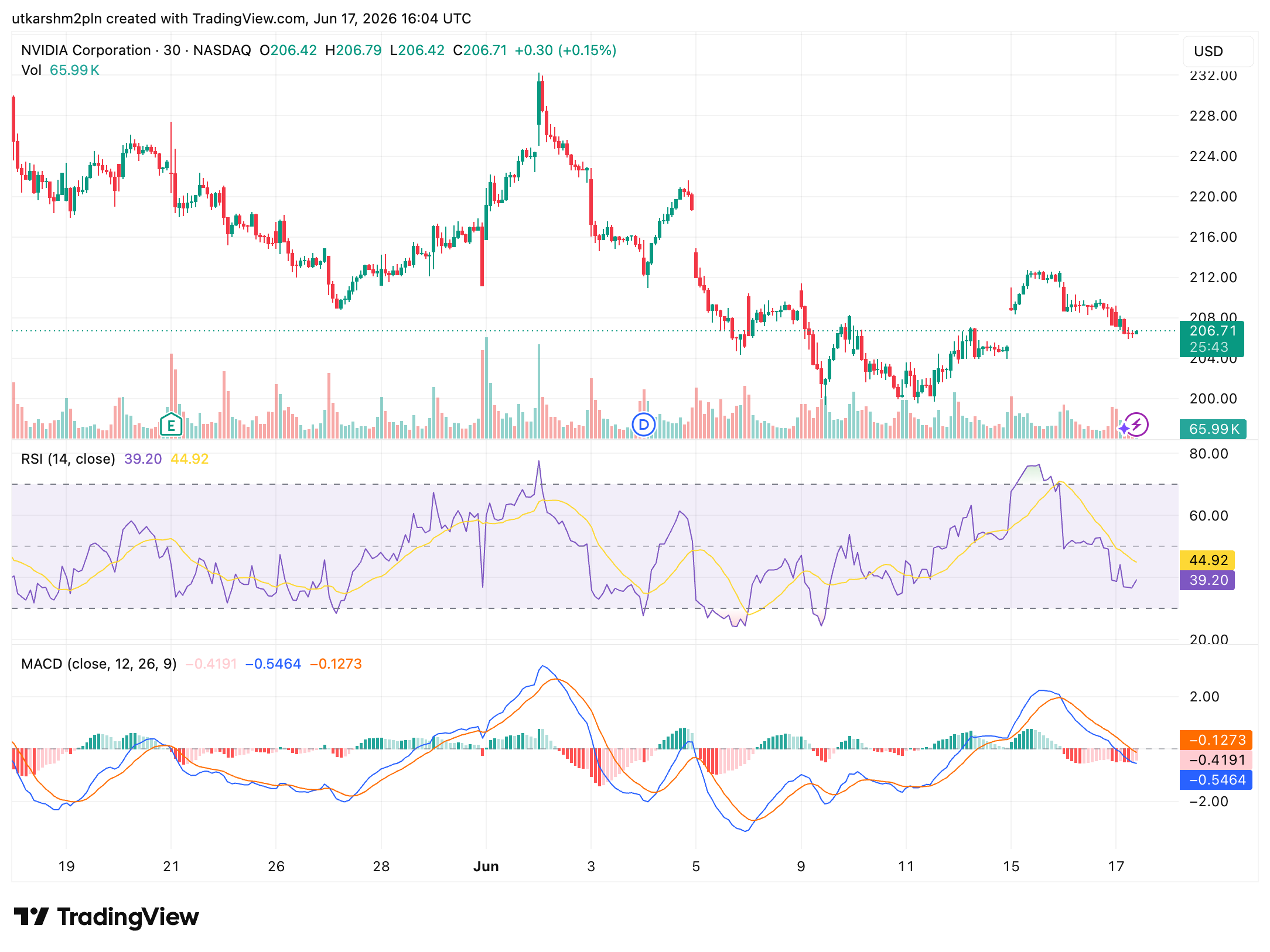
For now, the stock appears range-bound between support around $202-$206 and resistance near $210-$212.
A move above the upper end of that range would suggest buyers are regaining control, while a break below support could signal a deeper pullback.
Overall, the chart points to a cautious, neutral-to-bearish short-term outlook rather than a clear trend reversal.
The post Nvidia stock remains under pressure: can the AI giant breakout soon? appeared first on Invezz