Physical AI emerges as Wall Street’s next AI trade: stocks to consider
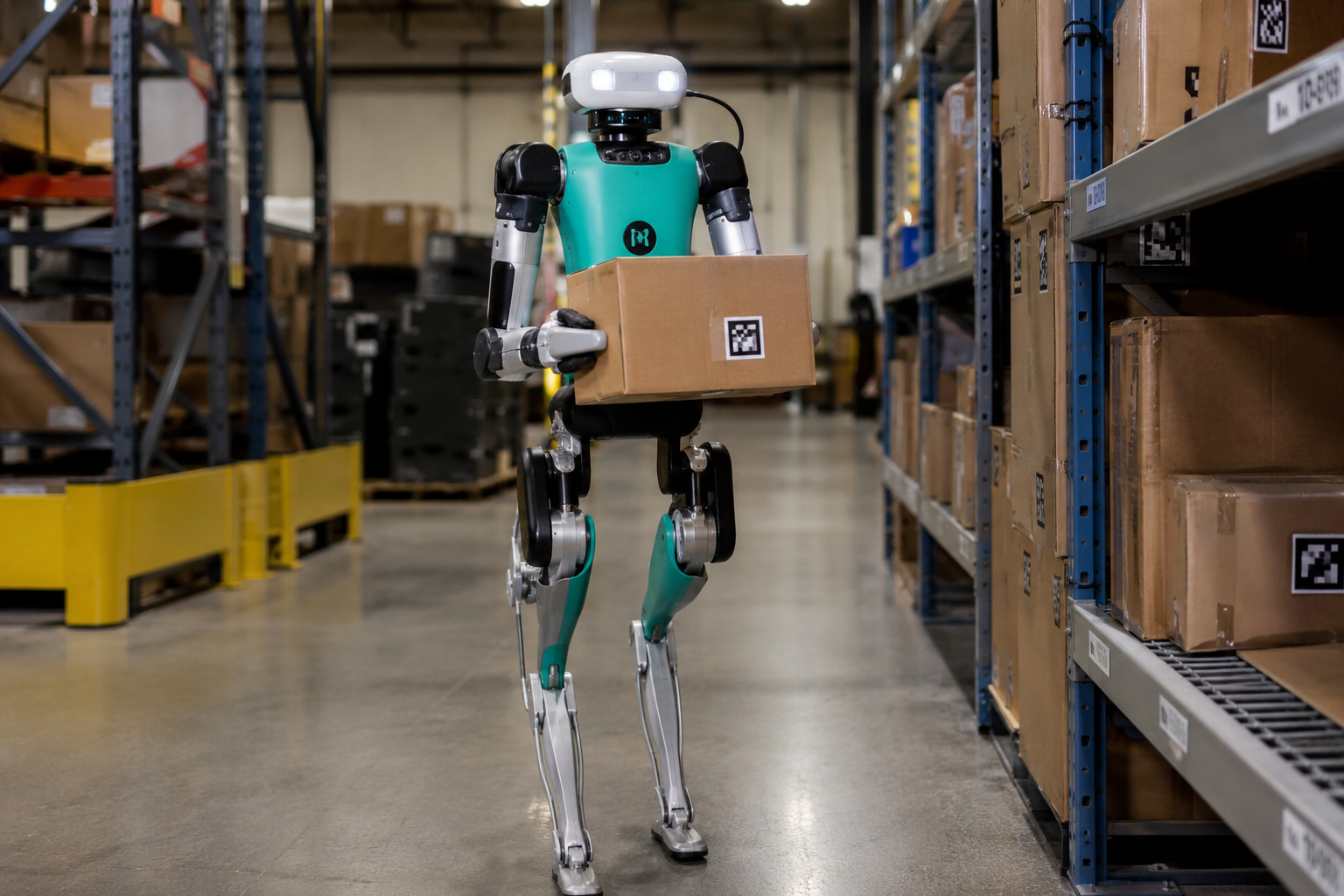
The artificial intelligence investment story is beginning to evolve beyond chatbots and data centers, with an increasing number of strategists and technology leaders pointing to robotics, autonomous vehicles and humanoid machines as the next frontier for long-term growth.
While generative AI has dominated markets over the past two years, investors are increasingly exploring what many describe as “physical AI” — AI systems capable of interacting with and navigating the real world.
The theme spans industrial robots, autonomous mobile machines, self-driving vehicles and humanoid robots, all of which are expected to benefit from advances in AI models and computing power.
Several leading Wall Street firms and technology executives now argue that physical AI could represent the next phase of the AI investment cycle.
Strategists see a long runway for physical AI
Raisah Rasid, global market strategist at JP Morgan Asset Management, recently identified robotics and autonomous vehicles as among the next major beneficiaries of the AI boom.
“AI is a story that is going to be here to stay for a long time,” Rasid said during a recent briefing.
“Mass adoption rate is really happening very, very quick, especially with generative AI.”
Her comments add to a growing chorus of investors arguing that the technology’s commercial potential extends well beyond software applications.
Last month, SoftBank founder and Chief Executive Masayoshi Son told CNBC that he believes physical AI and robotics are where the next trillion-dollar company is likely to emerge.
Barclays has also highlighted the opportunity.
Speaking to CNBC, Zornitza Todorova, head of thematic FICC research at Barclays and co-author of the bank’s “AI Gets Physical” report, said the humanoid robotics industry could expand dramatically over the next decade.
“The size of the market today is really small, it’s 2 to 3 billion [dollars], but we see it going up to $200 billion in 2035,” she said.
Nvidia sees robotics as its next major growth engine
Among the strongest advocates of physical AI is Nvidia Chief Executive Jensen Huang, whose company has become central to the AI infrastructure boom.
During a visit to South Korea last month, Huang described robotics as the country’s next major industrial opportunity.
“Because Korea is a manufacturing centre of the world, we can apply the robotics technology, the physical AI technology that we invent here for the industry,” he said.
Speaking later in the month at Nvidia’s annual shareholder meeting, Huang identified robotics as the company’s second-largest long-term growth opportunity after artificial intelligence.
“We have many growth opportunities across our company, with AI and robotics the two largest, representing a multitrillion-dollar growth opportunity.”
He also said autonomous vehicles are likely to become the first major commercial application of physical AI technologies.
Deployment expected to accelerate this decade
Barclays expects humanoid robotics adoption to unfold in two phases.
The first, running through 2030, is expected to focus on manufacturing, logistics, agriculture and construction, where labour shortages and productivity gains provide immediate incentives for automation.
A second wave after 2030 could expand into healthcare, elderly care, education and hospitality as the technology matures and costs decline.
The bank also highlighted China’s dominant position in industrial robotics, noting that the country now installs roughly half of all industrial robots worldwide.
According to Barclays, China deploys nearly 300,000 industrial robots annually compared with roughly 34,000 in the United States.
Robot density has increased by around 600% since 2016 to nearly 500 robots for every 10,000 workers.
Despite growing enthusiasm, most companies developing advanced humanoid robots remain privately held, limiting opportunities for public equity investors.
Instead, investors are looking at listed companies that provide enabling technologies or exposure to automation.
Ouster’s Lidar technology provides foundation for AVs and robots
One of those is Ouster, which manufactures digital lidar sensors used by autonomous machines to map their surroundings in three dimensions.
Lidar technology is widely viewed as a foundational component for autonomous vehicles, warehouse robots and industrial automation systems.
The company received a boost last month after its Rev8 OS digital lidar sensor family qualified for Nvidia’s DRIVE Hyperion autonomous vehicle platform, allowing developers to deploy its sensors throughout the vehicle development cycle.
Ouster shares currently trade around $44.64 after gaining more than 90% this year.
The company’s first-quarter product revenue climbed 55% year over year to a record $48.23 million, while total revenue increased 49%.
Gross margin expanded to 43%, and the company shipped more than 12,600 sensors during the quarter.
However, analysts also caution that Ouster remains unprofitable and trades at more than 23 times sales following its strong rally.
The consensus analyst rating currently stands at Hold.
Teradyne combines AI chip testing with robotics
Another company drawing attention is Teradyne, whose semiconductor testing business has become increasingly important as AI chip production accelerates, while its robotics division also grows.
Its Semiconductor Test division generated $1.11 billion in first-quarter revenue, while its robotics business contributed $91 million through collaborative robots from Universal Robots and autonomous mobile robots developed by Mobile Industrial Robots.
Teradyne shares have gained more than 66% this year and over 280% during the past 12 months.
Supporters argue that every AI accelerator, custom chip and high-bandwidth memory stack requires extensive testing, creating sustained demand for Teradyne’s equipment.
Still, analysts warn that the stock’s valuation has become demanding.
Management’s second-quarter revenue guidance of $1.15 billion to $1.25 billion implies sequential moderation, while any slowdown in AI infrastructure spending or tighter export restrictions on China could pressure investor sentiment.
RoboStrategy offers exposure to public and private robotics companies
Investors seeking diversified exposure have also begun looking at RoboStrategy (BOT), which listed in May as the first closed-end fund dedicated entirely to physical AI and robotics.
Its portfolio includes stakes in both public and private robotics companies, including Figure AI, Apptronik, Dyna Robotics, Standard Bots and Dexmate.
The fund recently secured a committed equity facility worth up to $2 billion with Roth Principal Investments to support future investments.
However, the fund has already experienced considerable volatility, with shares falling more than 13% since listing, underscoring the risks associated with investing in an emerging industry that remains in its early stages.
As enthusiasm around generative AI matures, many investors increasingly see physical AI as the next chapter of the broader AI investment story.
Whether that optimism translates into sustained market leadership may ultimately depend on how quickly robots and autonomous systems move from promising technology to widespread commercial adoption.
The post Physical AI emerges as Wall Street’s next AI trade: stocks to consider appeared first on Invezz