
Cellular IoT connectivity revenues reached €14.5 billion in 2025
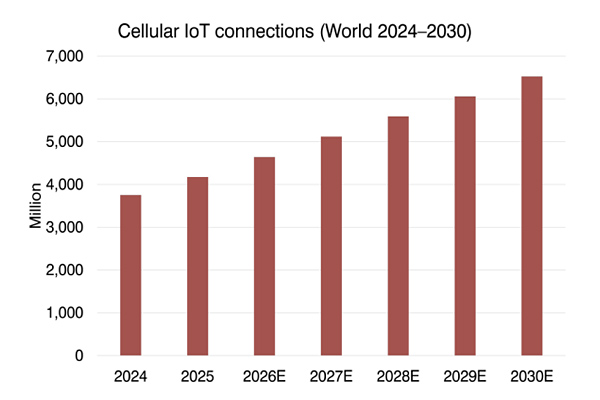
Berg Insight estimates that cellular IoT connectivity revenues reached €14.5 billion in 2025, while the number of cellular IoT connections rose to 4.2 billion worldwide. The figures point to a market that is still expanding in volume, but where revenue per connection remains under pressure.
Cellular IoT has become a scale business, but not necessarily a high-ARPU one. As more meters, vehicles, payment terminals, industrial devices and tracking units are connected to mobile networks, the economics of the market are increasingly defined by very large installed bases, automated lifecycle management and thin recurring connectivity margins.
That tension is visible in new data from Berg Insight, which says global IoT connectivity revenues increased by 5 percent in 2025 to €14.5 billion. Over the same period, cellular IoT connections grew by 11 percent to 4.2 billion at year-end, equivalent to around 32 percent of all mobile subscriptions. Monthly ARPU fell by 7 percent to €0.31.
The distinction matters. A market can be expanding in unit terms while becoming more demanding commercially for operators and IoT connectivity providers. The gap between connection growth and revenue growth indicates that additional devices are, on average, contributing less revenue per month than the installed base. For IoT buyers, this may support lower connectivity costs at scale. For connectivity providers, it reinforces the need to compete on platform capabilities, coverage reach, integration tools and operational efficiency rather than SIM volume alone.
China’s operators dominate the connection rankings
Berg Insight’s ranking also underlines how concentrated cellular IoT scale remains in China. China Mobile is identified as the world’s largest cellular IoT connectivity provider, with 1.48 billion connections at the end of 2025 and 5 percent year-on-year growth. China Telecom followed with 746 million connections, while China Unicom ranked third with 723 million.
That means the three Chinese operators together accounted for a very large share of the global installed base reported by Berg Insight. This is not simply a leaderboard detail; it shapes how global cellular IoT statistics should be interpreted. Worldwide connection growth is heavily influenced by the structure of the Chinese market, where the largest mobile operators operate at a scale that Western carriers do not match in IoT connection counts.
Vodafone ranked as the largest Western operator and fourth overall, with 234 million connections. AT&T followed with 160 million. Airtel in India stood out for growth, with IoT connections increasing by 115 percent to 69 million. Verizon and Deutsche Telekom were both in the 62–69 million range, while Telefónica and KDDI Orange were also in the top ten with about 59 million and 58 million connections respectively.
What makes this report more useful than a typical connectivity announcement is that it combines three views that are often presented separately: connections, revenue and ARPU. Individual operator announcements tend to highlight additions or platform wins. Berg Insight’s data shows the broader commercial pattern: connection counts are rising faster than connectivity revenue, and IoT remains a relatively small contributor to major mobile groups, accounting for 1–4 percent of service revenues among the largest operators.
Managed service providers become harder to separate from operators
The report also highlights the growing role of IoT managed service providers. Berg Insight says these providers had more than 250 million cellular IoT connections under management at the end of 2025 and generated around €1.9 billion in annual revenues.
This category includes companies such as 1GLOBAL, 1NCE, Aeris, BICS, Cubic, emnify, Eseye, floLIVE, Giesecke+Devrient, KORE, Soracom, Tata Communications, Teal, Telit Cinterion, Velos IoT and Wireless Logic, among others. Their positioning is different from that of a single mobile network operator. Berg Insight points to network-agnostic models based on roaming agreements, sponsored IMSIs and eSIM profiles, allowing providers to aggregate multiple mobile networks for customers operating across borders.
The practical implication is important for OEMs and enterprises designing products for more than one national market. A device maker embedding cellular connectivity into equipment may not want to negotiate separately with each local carrier or redesign provisioning processes country by country. Managed service providers can reduce that commercial and operational fragmentation, though they also add another layer that system integrators must evaluate for coverage, policy control, support and lifecycle management.
For mobile operators, the figures show both opportunity and constraint. Cellular IoT is a multi-billion-euro market and is forecast by Berg Insight to reach 6.5 billion devices and €21.5 billion in annual connectivity revenues by 2030. But low ARPU means that success depends on handling large numbers of devices efficiently. Billing, remote SIM provisioning, diagnostics, roaming control and integration with enterprise systems become central to profitability.
For industrial players, utilities and fleet operators, the report is a reminder that cellular IoT procurement is no longer only about radio access. The connectivity layer now sits inside a broader operating model involving eSIM management, multinational coverage, device onboarding and long service lifecycles. As the market matures, the winning providers are likely to be those that make large IoT estates easier to deploy and manage, not merely those with the largest number of active connections.
The post Cellular IoT connectivity revenues reached €14.5 billion in 2025 appeared first on IoT Business News.